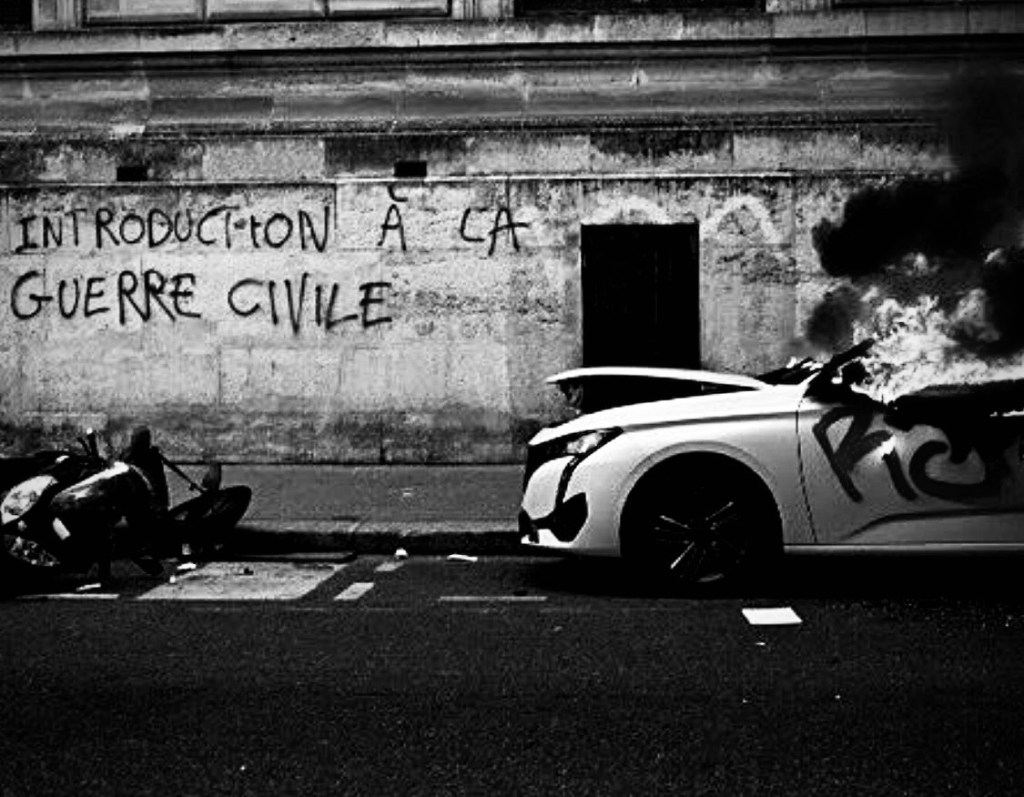
The fundamental challenge of the “coming politics” is not the realization of the presuppositions of modern philosophy, such that bourgeois modernity can operate without the open hypocrisy everywhere on display in today’s social war, but their overcoming. In this way, we may need to concede that this is no longer legible to the order we call the political – that clean space where qualified life has its edges delimited.
To do away with politically qualified life may mean something like the withering away, through a different comportment, of the threshold of the political which has always served to renew the state of exception at its most constitutive level.
If, as the acolytes of the soporific musicologist-turned-politician never tire of telling us, praxis is “everywhere blocked,” it is not that avenues are not available. It is that these avenues are ones that must depart from History – a move fundamentally unacceptable to those whose communism is comfortably posited within the continuity of successive disasters. Their hope is that a particular war can decide this global civil war, where Empire is always ready to invoke its “planetary thinking” in order to reground its necessity.
If we are faced with “blocked praxis,” we cannot, in turn, actively reject a refusal available to us: to “practice” a blockage rather than seek an actualization of a clean new political demand that makes objects of biopolitical administration temporary claimants in the court that seeks to ultimately liquidate them.
“We are already doing too much […] The political is, itself, a comportment, which we now take to be natural, actual, and necessary. The comportment towards being is the laying down of all other modes of comportment. It is the devastation of all possible politics.” (S. Annoyance)
A destituent politics must destitute the political. Retaining the polity, choosing only to reject its particular outcomes in favor of a different collapse, is clearly no longer acceptable to those who refuse. To recognize political life as “autarchic life” and then affirm this autarchy is not a celebratory assertion of one’s “rights” as an animal with the “additional capacity for politics,” but the most obsequious of metaphysical capitulations.
Destituency is not a tactic. To treat it as such is to reveal that one is invested in articulating a first philosophy, or a first politics, which already establishes the state of exception in advance. This treatment grasps, and chokes, the passive negativity it cannot understand and seeds in it a constituent potentiality. This tortured, transformed “destituent power,” the one of the American left that wants to operationalize everything, neutralizes any possibility of a real neutralization. Even refusal is to be grounded in a positive affirmation.
“Even our refusal takes the form of an operativity.”
The sovereignty of eugenic modernity no longer needs the constituted power of political subjectivity. Instead, it mobilizes the capacities which act as the expressed threshold of political existence. It affirms not one’s political subjecthood, but the conditions of possibility for that subjecthood. There is now a direct through-line which no longer needs the messy bourgeois mythology of subjectivity.
An ethics against the political, which terrifies precisely because it lays down that practice of gathering-up only to shovel into some furnace of history (the naturalization of production, the unification of a Multitude, it hardly matters), is open to us at every moment.
Our “age” is certainly marked by a refusal, but it is a refusal to refuse. Not at “the last instance,” there is no betrayal to speak of. No, the refusal to refuse is always what is realized in governance.
Written with Annoyance

