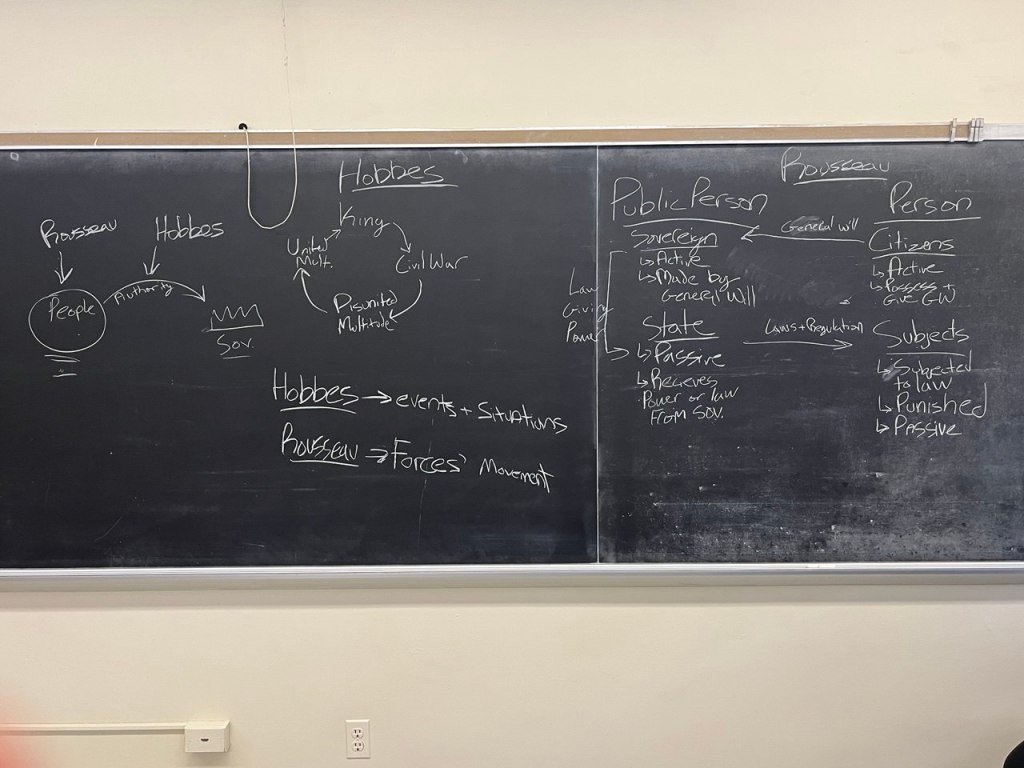
In the second lecture of Foucault’s course at the Collège de France, “Society Must Be Defended”, we are introduced to the discourse on right within modern political thought in the context of a prolonged war. This war will be, for Foucault, the object of his analysis. It will guide the developments, breaks, and shifts in the discourses of right and power through modernity. This discourse is a zone of war, and the world—the terms that dictate its appearance—is put at stake.
Two things are revealed when properly situating this “war”. First, contrary to the analyses put forward by the likes of Lazzarato and Alliez, Foucault never quite abandons the war that rages. The same things are always at stake, and it is ultimately the violent question of the intelligibility of ourselves. Second, and this is far more important than replying to any polemicist attempting to dethrone our anarchic Foucault, is that the shifting allegiance of the discourse of sovereignty within this war reveals something about our bourgeois democracy and our eugenic condition. We have not yet decapitated the sovereign. Instead, the sword of the sovereign the hangs over all of us interminably.
In this “how of power” that Foucault had been trying to deliver for the five years prior to this lecture, right functions as one piece of a tripartite schema within early modern and modern political philosophy. “So, we have a triangle: power, right, truth.” (SMBD 24). The traditional approach to political philosophy stages the three elements this way: how does the discourse of truth establish the limits of power’s right? Foucault’s question is different, seeking to reveal the anarchy beneath the discourse of power. He asks, instead, “[w]hat are the the rules of right that power implements to produce discourses of truth?”[1].
Right functions to ground power, but in the classical political-philosophical frame, it is set as the limit of power in relation to a particular truth (in which power’s necessity is grounded). Foucault refuses this inherent legitimacy of power. Right, for Foucault, intervenes ultimately to produce effects on subjects, rather than just speak to its necessity and limits. Its evocation is not one aimed at establishing legitimacy to power, its evocation instead sets particular “procedures of subjugation” in motion. With the traditional problematic of right and truth reformulated, what is at stake can be revealed in a new way. Instead of the simple question of obedience and sovereignty, we must instead speak of dominations and subjugations. While initially this may seem like a lateral displacement, it both broadens and deepens the analysis. With right being treated no longer as downstream of the traditional commitment to truth, and to the given, right can now be situated within its particular metaphysical epoch. This enables us to grasp what grid of intelligibility is functioning to allow sovereignty to emerge with its necessity. If we have yet to bypass the problem of sovereignty, it is not because the democratic revolutions have not come, it is because they shared the same objects of contestation. Royal power was contested on the ground of sovereignty, with a claim to right.
Foucault urges us that one thing must not be forgotten, and it is where our commentary is concerned: that the “elaboration of juridical thought has essentially centered around royal power”. Right serves as an “instrument of justification”. This polemic is not particularly profound, but cannot be forgotten when taking up the object of right. Right and absolute power remain tethered, and untangling the tripartite structure of the traditional political-philosophical problematic reveals, not without a hint of irony, that inseparability.
Right functioned initially for the “benefit of royal power”, but the criticism of royal power did not do away with the question right. It, instead, displaces it. The criticism of royal power, of absolute monarchy, does not do away with the absolute nature of sovereignty. The democratic-revolutionary tradition re-situates sovereignty within the population itself. Sovereignty trades away royal power for what we have deemed in “biopolitical absolutism”. The particulars of this absolutism are not what is at issue here, instead what needs to be focused on is a strange move regarding right and heredity in the dissolution (or dissipation) of sovereign power.
If the principle of the absolute monarchical power of royalty is heredity, we cannot say that the problem of heredity completely disappears from the discourse of sovereignty in the face of the destruction of royal power. “The king was the central character in the entire Western juridical edifice” (26). When the juridical edifice (the discourse of Right) is “turned against royal power”, the problematic of the character of the monarch does not simply disappear. The fragment of heredity shifts. It sidesteps from the Mandate of Heaven to the mandate of the human terrain of the population. If heredity was the basis of the claim to the office of the sovereign in the personation of the monarch, the stakes of that claim remain even when the throne is dissipated across the population. If wars are waged for all of us, and the basis of sovereign power is the potency and capacity of the population, then at any point our individual station is stake. If the “western juridical system” was “all about the king” prior to the question of right escaping royal control, what needs to be grasped is the principle of its totality.
In the greatest counter-insurgent text before Rousseau’s Social Contract, Leviathan, sovereignty carries with it “constituent elements” that operate as the “soul of leviathan”. Hobbes’s “schema”, where the artificial person of the sovereign is “no more than the coagulation of a certain number of distinct individualities” needs to be examined further than Foucault allows himself to in this lecture in January of 1976, because he is situating himself explicitly against the explicitly Hobbesian downward trajectory of an analysis of power. And while he will return to this question of “constituent elements” specifically when introducing biopolitics later that March (and it is our contention that constituent power is nothing other than biopower in its most machinated and ontologically violent form), we ought to meditate on it specifically within the context of the question of sovereignty, monarchy, and democracy. Foucault wants us to shift from focusing on the constitution of the sovereign to the constitution of subjects or the fashioning of subjectivations within discourses that produce particular subjectivities as effects. In doing so he enables us to understand two parallel operations occurring at that moment where the discourse of right escapes royal power and, in fact, turns against it. The first, as we have stated, is that heredity has shifted from the claim of the character of the king (at the center of the discourse of right) to the question of the subject and their relation to the social body. We are all kings, what a miserable state to be in. The second pertains directly to the emergence of parliamentary democracy and its relation to “the humanities”. Democracy elevates the “least man” to principle of sovereignty, making of the “least criminal” an object of absolute risk which must be seized upon, examined, and corrected (Discipline & Punish, “The Carceral”). Inasmuch as the least man is the principle of sovereignty, it is only because he is always at stake in the species, and putting the species at stake.
If we have not yet abandoned the “model” of Leviathan, it is not because we have a shortage of decapitated monarchs and bourgeois uprisings. It is instead because sovereignty became “coextensive with the entire social body”, but not in the manner as it was in feudal society (SMBD 35). Instead, sovereignty is submerged and coextensive with the human material, those manipulable and refinable potencies, of the population. Wars are not waged for kings, but they are still waged for the sovereign, who is in cut out of your guts.
Discipline & Punish is a masterwork on the dissipation of sovereignty across the social field, as the social field emerges as the fundamental problem of regulation. However, “Society Must Be Defended”, because it makes of the social itself, instead of the scaffold, its initial space of inquiry it is able to approach that turn from “sovereign power” to “disciplinary societies” in a different way. Foucault is able to slowly uncover that social defense becomes the first and absolute principle of this new kind of sovereignty, which is where biopolitics emerges as the only politics.
In Psychiatric Power, Foucault articulates that sovereignty disperses itself across different institutions which are able to place subjects under different depositions and subject to decisions. Here,Foucault attests that the “king’s fall” is “not the same we find in, say, a Shakespearian drama” (Psychiatric Power 21). The finality of the sovereign decision being wrested from the monarch does not leave them wandering like King Lear. Instead we are faced with George III, whose madness “fixes him at a precise point and, especially, brings him under, not another sovereign power, but a completely different type of power”, that of disciplinary power. That diffuse, interrupted yet continuous, form of power no less grotesque or macabre than the scaffold, where our splayed flesh is traded in for a legible figure that bears down on us with the name of the “juridical subject”. Foucault says it is not Richard III of The Tragedy of Richard III, which is also certainly true. But there is a Richard III in Shakespeare where what is at stake in the question of the humanities (of the humanness of power in the disciplines) is made abundantly clear – carrying with it that biopolitical kernel that lays dormant in political-philosophical treatises at least as far back as Xenophon, Plato, and Aristotle. It is the Richard III of The History of Henry VI. A defeated Henry VI sinks into the madness of learned men in a tower in London, but is able to drift back from his bookishness fugue state to remind Richard, then Duke of Gloucester, what he is – “an indigested and deformed lump” (3046). Richard kills Henry, not simply to clear his path. Richard stands, crooked, the boundaries of the Anthropos. He therefore is a villain with one crooked limb in the age of monarchy, and the other reaching out to our eugenic modernity. He does not have the literal stature (orthos) of a political animal.[2] To kill Henry VI is to desperately take hold of the hereditary claim he can make, having been cast from the brotherhood of man – from the human terrain of the Multitude. He kills Henry not simply to clear the path, but in clearing the path claims the only heredity he could have – having been cast from the brotherhood of man he is left only with Sovereign right.
That I should snarl and bite and play the dog.
Then, since the heavens have shaped my body so,
Let hell make crook’d my mind to answer it.
I have no brother, I am like no brother;
And this word ‘love,’ which graybeards call divine,
Be resident in men like one another
And not in me: I am myself alone. (3075-3081)
“I am myself alone.” Richard III, in his vile murderous act, calls out from the inclusive exclusion of the metaphysical apparatus of the political animal and decides to play the dog and bite. Eugenics is nothing other than the transposition of the concept of heredity from the throne to the species.
One is noble born; one is a king. One is well born; one has a life worthy of living. If democracy truly is the dominion of the people, it is in the constitution of people (not just a people) where its operative circumscription lies. Democracy stages a people, surely, but first it must make of the person a problem.
An inhuman monster can rule, this is the unacceptable possibility Rousseauians simply will not tolerate. Rousseau secures sovereignty against such abominations. The moral (unnatural) inequality that plagues the monarchical order finds its tragedy in the possibility that an “imbecile can lead a wise man” (Basic Political Writings 2nd Edition, 92). The “reactivation” of the theory of sovereignty in Rousseau operates to propose an alternative to absolute monarchy: “parliamentary democracies” (SMBD 35). But the principle of these democracies is no less absolute, and perhaps far more malignant. It is an absolutism of biopolitics. What we ought to reveal to Rousseau is what my friend revealed to me in annoyance, “the multitude, the social itself is the first and greatest monstrosity”. “Madmen and naturall fooles” cannot authorize, they are not party to the united multitude (Leviathan Chapter XVI, 103).
In the disciplinary society, and the control society (if such distinctions are meaningful, I am increasingly convinced they are not), the absolute principles of sovereignty are still at play – we are all at stake in them. We all must make a claim to the throne of humanity, yet usurpers beware – do not degenerate the precious multitude.
If the democratic-revolutionary tradition freed us from the misery of monarchical servitude, the tragic trick it played on us was that it truly did make every man a king. The sword of Damocles hangs over us all as we stand at the threshold of our right to life.
[1] Foucault will return to this framing of the traditional “philosophical-political” question years later when establishing a distinction between the Socratic-Platonic mode of philosophical and the cynic (anarcheological) mode of questioning in On The Government of the Living.
[2] Aristotle, Politics. For the sake of thoroughness, it is worth noting that Richard III likely did not have the stature Shakespeare described. However, this literally changes nothing. It is crucial to Shakespeare that Richard III is presented this way.

