
I.
When asked where he was “situated” politically, the late philosopher, Mario Tronti, answered that he was a member of the “defeated party” in the “Benjaminian” sense of the term.[1] Today, in the imperial core, we stand defeated. I return to this comment from 2015, to this attestation of defeat, only to better understand what it means to bear witness to the victor. As I type this evening, mothers are grieving their lost sons, and sons their lost mothers – murdered by a blatantly genocidal regime; a regime upheld and armed by an empire that, though facing its illegitimacy globally at every moment, remains victorious.
There is nothing worse than a citizen of an empire in a moment of victory and slaughter. Even Nietzsche knew of the vomit inducing nature of the citizen who voraciously consumes death as an utterly alienated practice of being informed, and treating it as the “latest delicacy.”[2] There is a liturgy of reacquaintance with one’s old predicates that accompanies every new set of bloodied teeth. A false attempt at rebirthing a constituency in a new totality baptized in this blood, a united congregation is demanded. We are guilty of ruining the service and corrupting the flock. Even in its vanquishing of those it reduces to a statistical oversight, it demands a recognition of the specter of loss.
We are told we must publicly grieve for those who partied at the gates of an open-air concentration camp, while ensuring that any tear shed for those living under a permanent state of exception is qualified with a litany of excising maneuvers and condemnations. We are told we must preface our refusal of the present with a disapproval of—or at least a distinction from—any force that is applied upon the victor. We are told that even a request for a suspension of a genocide is, in fact, hateful. We are told by the former Secretary of State that, in our grievances, we provide for their enemies.[3] These enemies remain perfectly amorphous and undefinable, so as to ensure they are everywhere like vapor – perhaps even under the corpses of children. We are told that those who dissent stand guilty of valorizing terrorism, which is a powerfully meaningless term in the mouths of defense bureaucrats. And yet we are told that they are unquestionably stable, and we are exasperated, desperate, and hysterical – perhaps we are even dangerous.
II.
The assertion of danger is for the vanquisher alone to attest. The ocular mechanism is wielded by power alone, and this is not a technology of governance that can become a ground of contestation and reappropriation. This risk assessment by the victorious remains their tool, and theirs alone. Risk is the basis upon which terrorism can present itself as a virtual object, with no need to validate a relation to the present state. Global defense, like social defense, is the double movement of mobilizing the population in its entirety while simultaneously declaring that it is completely at risk. Of course, we among the defeated know this. And it is this that necessitates our defeat at all costs. It is explicitly because we know them, but refuse to understand them that produces our civil war. It is because we do not appropriate their world, but instead stray from it, that they must constantly seek to reinscribe us as an enemy within. We dwell here with them, but do not adopt their gestures, and whichever ones we do adopt we are reduced to. The dangerous individual in the imperial core, the terrorist, lurks in every straying body, every voice out of tune, and—importantly—every member of the defeated party. Everywhere a contingency is defeated and rendered dangerous is precisely where eugenic civilization can claim a fearful victory. The vanquisher is always writing their own eschatological treatise.
Benjamin is tragically prophetic; the enemy has not ceased to be victorious. And, as we are compelled—without success—to condemn those who dared to escape their prison, it is clear that even the dead (many of them children who have only ever known occupation) are not safe. However, just as the enemy has not ceased to be victorious, it is clear that we, in our defeat, have not ceased to be dangerous. This is perhaps the definition of hostis. Hostis is not the struggle to be dangerous. Rather, it is the struggle that necessarily accompanies being recognized as such.[4] Now is the time to recognize that recognition, and to get organized on that basis. It is through a careful analysis of their counter-insurgency that insurgency can once again be thought. Encircled by the concrete of the metropolis and the network of Empire, exposed opposition that claims to be outside its solidified expanse expectedly fails.
Accepting our position in medio is the only truly ethical means of initiating our refusal. We should not falsify our own situation to ourselves, like the liberal existentialists and cosmopolitan academics who declare themselves to be “citizens of the world,” so long as this world maintains their comfort. We must accept that we are the wretched denizens of the imperial core. And it is here where our defeat becomes informative. We must come to know how they came to know us. They know that there will never be a society without resistance, because every empire is predicated on the promise of putting itself existentially in danger – to produce a need to pacify the world. We do not need to engage with their dialogues; the public sphere is, and always was, a zone of exception. We do not need to lure out their “true intentions” in a discourse as they send weapons and advisors to aid in the massacre. They do not hide anything from us. It is precisely this total mobilization that is occurring before us that must be taken seriously. What is happening in front of us (but always at that comfortable distance hegemonic power promises) in Gaza is the thanatopolitics that ensures our monstrous biopolitically managed heaven in the West.
III.
Returning to the late Tronti, in his criticism of democracy, he notes that western democracies are fundamentally a technology of a biopolitically normalized “Last Man.”[5] But what must be underlined is that we last people, with our poisonous comforts, are also uniquely violent in our supposed finality. Tronti argues that our present situation is a state of normality, and opposes such a state to “periods of crisis” and “states of exception.” He is correct, inasmuch as Empire is always an empire of the norm. But such an empire’s condition of possibility is the state of exception. It is only through the generalization of the exception that a norm such as this can find its claim to life.
If, for Benjamin, the state of exception can only be understood as law becoming indistinguishable from life, then one cannot deny that normalizing power exists within the state of exception. The norm can reign in Canada, as it passively euthanizes its undesirables among the population with a polite smile, so long as the death machine can raze refugee camps with the false justification of a mere possibility that it can neutralize one individual resistance fighter. This is the biopolitical principle.
These grotesque military actions we have contributed to and watched must be examined with a morose clarity. The survivors doubtlessly know that they are the target. What is important from our position of geopolitical insolation, as spectators with burned retinas, is not whether this individual was the target. Instead, citizens are instructed to ponder, in a fearful comfort, whether he was dangerous, and if he was… well… all assaults are permitted…
According to the occupation forces, one resistance fighter (who may or may not be present), is worth hundreds of civilian deaths. We know, obviously, they are not asking us to take such a strange utilitarian calculation seriously. Instead, they are exemplifying what is latent in eugenic modernity. The entirety of the occupier’s population must be simultaneously folded into a standing army in reserve and, at the same time, be entirely feeble and on the brink of catastrophe. The risk is biologically unacceptable, even with the existence of one fighter. It is not because the technology of warfare developed in the direction of complete destruction that entire populations are vanquished, it is precisely the opposite.
Entire populations must be held out and suspended in the realm of death, because the occupier attests that their own vitality depends on it.
IV.
What we are witnessing are the horrors of a refined thanatopolitics.[6] A thanatopolitics where “letting die” in order to make the occupation live becomes a mode of management that is as unnoticeable to the docile media consumer in the United States as the biometric surveillance mechanism they perpetually consent to.
However, this should not lead one to believe that this genocide is “merely a preview of what is to come.” Such a view is as pathetic as it is repugnant. And it rings in our defeated ears like the cries of orthodox Marxists who make of MAiD a historical interlude foreshadowing the “fate of surplus laborers,” who would constitute true victims, or the malignantly misdirecting historians who treat Aktion T-4 as something distinct and only a presage to the Holocaust.
Transforming this into a spectral apocalyptic shard for the citizens of the imperial core to fear only enables them to staunchly place themselves in the role of the victorious victim of a history they, oh so sadly, continue to determine. And, more malevolently, it quietly reasserts the distance that imposes an impossibility of sharing resonances or being able to witness what is happening – what our defeat is helping enable. It is an empty pessimism making itself out to be theoretical insight.
V.
Surgical and simultaneously absolute destruction is the dominant method of the colonial occupiers. The atomic era has not yet produced a third nuclear attack, but the principle of devastation that it gave rise to is the morbid guiding light of our genocidal and eugenic age. As of this evening, occupation forces have dropped more than 18,000 tons of explosives on Gaza –twice as much tonnage as was dropped on Hiroshima.
A nuclear weapon does not have to be deployed from a submarine; it does not even need to be present in the theater of war. It is instead a biopolitical paradigm that operates within the enduring state of exception it initiated. Palestine, disciplinarily, is the most heavily surveilled occupied population on Earth. The dovetailing of the panoptic world and the biopolitical fabric of technologies of devastation produces—for us in the imperial core—the conditions of maintaining a norm. Our comfort is always safeguarded by this subtle slaughter.
Every quotidian instance in the imperial core carries with it a fragment of atrocity.
VI.
Some who demand a condemnation of the resistance, in a public display of piety, claim to be expressing their universal opposition to violence. They are the most crudely violent, because they seek to dissolve all the political elements within any gesture of resistance. Such preachers seek to turn resisters into pathological objects, ceding the entirety of the struggle to Empire and, specifically, the colonial occupiers who are doing the same. Those who cannot distinguish forms of violence fail to make such a distinction because they have quietly found themselves folded in and content with the barely hidden violence and policing of everyday life that ensures their comfort and private property. When they bloviate about struggle, it is not just “decontextualized.” Violence is stripped from the world in which it manifests and wrested from history. While revolts burst through as a suspension of a history, those revolts nonetheless belong to that history and emerge from it. They claim to oppose terrorism, without once reflecting on what terrorism means in this epoch. The terrorist is not a position ontologically prior to ocularity. One is deemed a terrorist. As we in the imperial core have seen, and those we failed have experienced, being Palestinian is a sufficient condition to acquire that label. To be a terrorist is simply to be party to anything that seeks to dissolve Empire’s unified multitude.
VII.
The tear, half,
the sharper lens, moveable,
brings the images home to you.
– Paul Celan, “The Eye, Open”
And I want to scream out
you’re all of you living in a dream.
– Louise Glück, “Averno”
There is a moment after you move your eye away
when you forget where you are
because you’ve been living, it seems,
somewhere else, in the silence of the night sky.
You’ve stopped being here in the world.
You’re in a different place,
a place where human life has no meaning.
– Louise Glück, “Telescope”
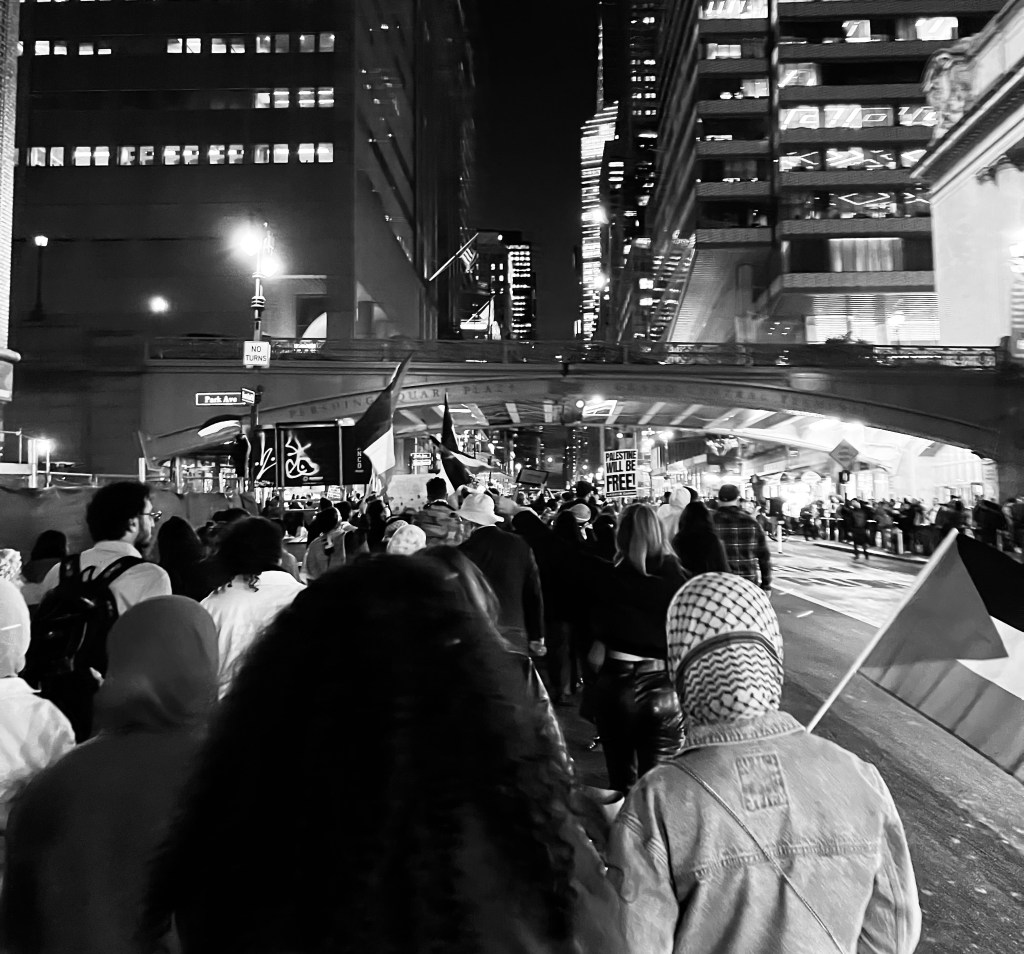
As we watch, we do not witness what is experienced by the mothers, fathers, and children beneath the missiles that we, every day, consent to launching. We, in the defeated comfortable hideaways of Empire, could never adequately bear witness to such unspeakable violence; especially when we dwell with its perpetrators. There is a double meaning to our defeat, which comes with a particular promise. We fail not only as the defeated party, but we also fail as witnesses. Our gaze, however, must not move. It must remain fixed though it fails to bear witness.
This failure, however, is not in praise of a political pessimism. A friend of mine once wrote to me that the distance between those who testify to bleak inevitability, while embracing it, and those who seek to technologize their situation is miniscule. This is not how we must live in the core of this Leviathan. We must continue to fail at testifying to the truth. And while we cannot bear witness to the hellfire we have wrought in our defeat, we can—and will—bear witness to our empire and its citizens. We are not going anywhere, even in this defeat, we will stay here, and continue to gaze upon the victors.
We ought to be a bit clearer about what failure attests to. To “fail” traces back to the Latin fallo (fallere in the present infinitive), which means to “deceive,” “slide by,” to “beguile”, or, literally, to trip or to “cause to fall.”[7] We will continue to attempt, at every opportunity, to find routes to slide by, and methods to deceive.
The ocular mechanism can only operate along the lines of recognizing, categorizing, and subjectivating. Ocularity cannot gaze upon itself. The eye of power never turns against itself, but those it gazes upon can stare back. To speak the truth now is not an act of courageousness, but a discomfort in our existence. A discomfort that must be inseparable from each and every moment of our existence. Our gaze cannot move, and our refusal must remain present in this world – even in failure.
We must fail until, like all empires, the defeated party causes it to fall.
From the river, to the sea...
[1] https://autonomies.org/2023/08/mario-tronti-i-am-defeated/
[2] Nietzsche, On the Uses and Abuses of History for Life, §5
[3] https://www.youtube.com/watch?v=KwLz-pUpF6c
[4] After all, Cataline was within the walls of the city when Cicero deployed the term.
[5] Tronti, 2009. “Towards a Critique of Political Democracy”: https://cosmosandhistory.org/index.php/journal/article/view/127/229
[6] On the refinement of biopolitics and thanatopolitics in the colonial occupation, read: Ghanim, Honaida. “Thanatopolitics: The Case of the Colonial Occupation in Palestine” in Letin, Ed. Thinking Palestine. London: Zed Books.
[7] Charlton T. Lewis & Charles Short. A Latin Dictionary. Available at the Perseus Digital Library.
 RevoltingBodies
see you folks may have claire colebrook on the pod, hope you get to her vital work the machinic guys had her on and talked about everything but for 2 hours.
LikeLike