Outline of Variations of the Economic Presence of the Body (collaboration with Professor Joseph Lemelin)
This is a DSC4 Presentation Manuscript
[Introductory comments]
[Freedom for Palestine, power to all those resisting Empire.]
Eugenics has not returned. It has not returned because it has never left. We must be careful with narratives about resurgence, whether they be of the despotism of world leaders (which are becoming increasingly pathologized) or popular reactionary politics. These attestations make the same error that certain theorists of eugenics and fascism do. They presuppose that these developments were complete breaks from the governmental rationalities that were concomitant w them. Our age is one of the refined management of life. We are increasingly governed by a rationality that seeks to simultaneously capture and render intelligent the smallest alterations in behavior and the most general population-level data possible.
We are living at the threshold of eugenic modernity.
What I and my peers, Samuel White, Julian Herron, and Violet, call “eugenic modernity” must first be given at least a cursory definition (and it may vary from theirs). If Foucault’s “threshold of modernity” is reached precisely in the moments when the life of the species is put at stake in political strategy, eugenic modernity is the added caveat that political strategy seeks to define and optimize this life. What eugenic modernity renders explicit is the eugenic commitment in the governing of disability. However, importantly, this perspective reveals not just how crisis is approached through a eugenic lens, but that crises that define of our philosophical opt for a eugenic resolution. Eugenic modernity is the thought of crisis.
There are now tomes of analysis of “crisis” capitalism or the “poly-crisis”. But it remains crucially underexamined philosophically. This is due, in part, to the fact that analyses of neoliberalism, biopolitics, and eugenics, must be undertaken genealogically. There have been attempts at trying to understand Foucault’s relationship to neoliberalism. Each end with a rather shocking articulation – that Foucault’s work loses an insightful value upon the advent of neoliberalism. I would like to show that this is, if not entirely incorrect, at least the result of a misreading. However, I will spare you an entire presentation of polemics about Foucault scholarship – although it is desperately needed. These accounts of Foucault fail to recognize that what is the object of analysis is not simply the management of labor, but the micropolitical management of the laborer. In short, what critics of Foucault’s account of neoliberalism miss is his persistent disclosure of neoliberalism as an ableism. Again, we can talk about why orthodoxically Marxist responses to Foucault may not be oriented towards registering the function of disability within neoliberal capitalism, but that is for another needed project.
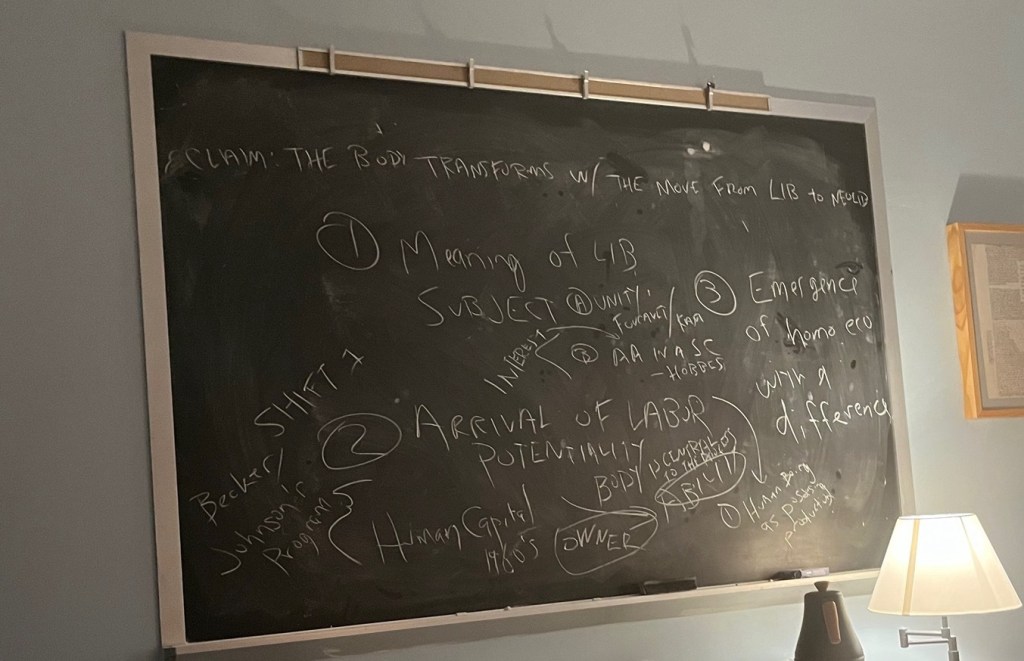
Next, we have to approach neoliberalism and what makes it unique. Ability is the apparatus that establishes a shift in liberalism’s approach to the body and to the economy. It is the new approach to human capacity that gives rise to a new economic theory of labor – one grounded in new kind of Homo Oeconomicus: human capital.Eugenic modernity relies on an epistemic grid that individualizes bodies through ability. In order to make this case, we will look to Foucault’s account of neoliberalism in his often-cited, but rarely understood, Birth of Biopolitics lectures at the college de France and analyze the Gary Becker’s foundational neoliberal text, Human Capital.
Finally, we will discuss a different crisis. In the work of Shelley Tremain, what is put at stake is often philosophy as a practice that is meant to give an account of who exists, how they exist, and how they are to be managed. This argument has its highest stakes in fifth chapter of Foucault and Feminist Phil of Disability, in the analysis of bioethics as a technology of governance. Tremain writes “the academic discipline of bioethics relies on an epistemology of domination and is an institutionalized vehicle for the biopolitics of our time.” I would like to, briefly, articulate how two philosophical disciplines—contemporary political ecology and posthumanism—reveal how disability is an apparatus for the crisis of thought. Far from having dispensed with the unified subject, disability reveals how the conditions of that unified subjectivity must remain intact in ableist modernity for the philosophical programs of both deep ecology and posthumanism to function internally. Disability must be prior to any discursivity, in order to hold secure a notion of human capacity and agency.
So, if neoliberalism is a new kind of crisis management, it has to be understood through the lens of disability and the history of eugenics. The thought of crisis can no longer be separated from the eugenic commitment, and our eugenic modernity must be understood through this history of crisis.
First, Crisis:
Any adequate genealogy of crisis, which is not what I intend to provide (only lay out), has to start with its philological origin. Crisis and decision [krisis] are the terrain of the physician. Nowhere is this clearer than in the foundational Hippocratic texts. Hippocrates’ physicians were to familiarize themselves with the temporality of disease, and sink into it. They were to note the development of every lesion, the change of tone on every inch of the epidermis, the rhythm of breathing, the disposition of the patient, the way they placed their feet, even in what positions they slept, not merely for diagnostic purposes, but for prognosis.
Any good physician for Hippocrates is one that practices forecasting, but inevitably a decision must be reached in that critical moment. This moment of crisis in the development of a disease, for Hippocrates’ physicians, is the moment of attack, because it is the moment of truth: both for the patient, where the outcome of this critical moment determines whether they are to survive their affliction, and for the physician. For the physician, the moment of crisis is the point of determination. It is the very object of the accurate forecast. There is a decision that must be made, a judgement.
“Life [ho bios] is short, and Art [Tekhnē] long; the crisis [kairos] fleeting; experience perilous, and decision difficult” (Aphorisms I. I). Decision is difficult, its moment dwells like a shard of splintered time in that chasm opened up by the crisis. Krisis meets crisis. Decision and crisis intertwine and, often, determine the nature of the emergence of the other.
Crisis has always had a simultaneously medical and juridical function. But originally it was confined to a decision about a body, in its privacy. But this notion of crisis, and the concept of the management of health itself will change when the critical moment is transposed – when crisis finds meaning within the sovereign decision pertaining to the social body itself.
Foucault, in his 1973 lecture series, Psychiatric Power, gives a delicate and almost torturous account of the disappearance of the medical notion of crisis. in its general form the technique of the crisis “Greek medicine is no different from the technique of a judge or arbitrator in a judicial dispute. In this technique of the test you have a sort of model, a juridico-political matrix, which is applied both to the contentious battle in a case of penal law and to medical practice” (PP 244). It is localized within the body. In the eighteenth century this concept of the medical crisis all but disappears from clinical texts and treatment procedures. But we have to take note of what replaces this concept of the crisis, as I think Foucault will gloss over something crucial – social defense. “it is clear that the psychiatric hospital, like the general hospital of medicine cannot tend but to make the crisis disappear.” For Foucault, the disciplinary system gets rid of this notion of crisis. However, a new kind of crisis manifests, one that Foucault only touches on but does not fully identify until his account of social defense. Foucault briefly states that the psychiatric interest in crime is an “attempt to demonstrate” not that every criminal is mad, but that every mad person may be a possible criminal. While crime and its punishment are not the focus here, I want to note that Foucault is clearly recognizing that there is a territorial shift in the function of crisis and its temporality. Yes, the crisis has faded from the body of the patient, but in the same move it transitions to the social field. The body of the patient testifies to the social body, either to condemn it to danger or to be isomorphic with its productive processes and its policing (after all, this is what the docile body is). We have to look to Foucault’s later lectures, Sec. Ter. Pop. and Birth of Biopolitics, to understand this new form of crisis. Its temporality changes. Now crisis, much like the looming threat of crime understood through abnormality, is the milieu of management. image of the crisis and its relation to judgement is the modular milieu of physiocratic economic management. The Government of security and of population has a completely different approach to the temporality of the crisis and the way in which judgement and management take place. In the physiocratic government of security, from Abeille to Smith to Quesnay, what manifests is a new “way of conceiving and programming things” (Foucault 2007, 41). Foucault focuses on the way that physiocratic modes of governance dealt with the concept of scarcity. No longer will grain scarcity be treated as an isolated crisis around which all decisions must be made and then eventually an action be taken to prevent it. Instead, scarcity will now be treated as a something that “must not disappear” (Foucault 2007, 42). The crisis is now the expanse across which the state, as a constant practice and not simply an entity charged sovereign intervention, will manage the population. The crisis has shifted away from being confined to the space of the body under the medical gaze, now the doctor must be practitioner, judge, and social manager. This lingers today in the DSM-V’s definition of abnormality: “maladaptive behavior, personal distress, statistical rarity, and violation of social norms.” As Julian Heron notes, “the threat presented by discordant bodies organizes the very fiction of a unified society.”
So why do I open with this insufficient account of crisis? My answer is rather simple, if crisis is the reigning object of contemporary economic analysis, liberal or Marxist, we have to understand that it is not a set of emergenices that arrive at a specific maturation of contradictions but is, in fact, a mode of governing that has been with us since the eighteenth century.
Next, Neoliberalism needs Ableism for the crisis to be maintained:
In his 1979 lectures, The Birth of Biopolitics, Foucault talks about, well, the birth of biopolitics. He believes that, in order to do this, in order to give this history, he has to give an account of post-physiocratic liberalism and neoliberalism. So what is unique about neoliberalism, Foucault asks? The answer is a kind of strange one. The shift from liberalism to neoliberalism can be understood in this way. Economics is no longer an analysis of a process (think commodity production), but of an activity. It is no longer a logic of processes but instead a “strategic programming of individuals’ activity.” Foucault summarizes American neoliberalism this way: “American neoliberals say this: It is strange that classical political economy has always solemnly declared that the production of goods depends on three factors—land, capital, and labor—while leaving the third unexplored.”
This new analysis is one that focuses not on the deployment of labor potentiality, but an incision into the laborer, their value, and their—importantly—abilities. This is the theory of human capital, a term we often hear but rarely actually discuss the content or strategic function of.
Gary Becker, a neoliberal economist whose foundational 1964 text Human Capital came to define a new mode of investment, set out initially to “estimate the money rate of return to college and high school educations.” What Gary Becker attests is that this new approach to capital, the investment not just in labor, but the laborer, would “fill a gap in formal economic theory: it offers a unified explanation of a wide range of empirical phenomena.” But what’s fascinating about this account, is that it relies on a concept of human investment entirely predicated on what Becker calls “ability.” Human capital is a mode of investment that seeks to identify, facilitate, and foster ability. No longer is the laborer simply the harbinger of labor potentiality that is abstracted as a broader processes of production. Instead, the human being becomes a new kind of Homo Oeconomicus. The laborer’s assets comprise a capital that is an “ability, a skill: as they say” Foucault says, clearly turning the knife on Deleuze and Guattari, “it is a machine.” And this machine is what must be invested in. However, on the other end, it is also meant to recognize risk, or “lesser ability.” In his analysis of the variation in rates of return, becker lays out the three important measures of “ability” in his study—rank in class, IQ, and father’s occupation. All of this is meant to allow economists to gain a new perspective on capital, on that is found as an asset to the laborer. Becker writes “adult human capital and expected earnings are determined by endowments inherited from parents and by parental (x) and public expenditures (s) on his or her development”. With this framework of investment comes, of course, risk. And it is this risk that Foucault wants to focus on in a rather shocking way. Foucault qualifies his statement saying that he is engaging in a “bit of science fiction”. He attests, clearly pulling from Becker,
“…one of the current interests in the application of genetics to human populations is to make it possible to recognize individuals at risk and the type of risk individuals incur throughout their life […] Putting it in clear terms, this will mean that given my own genetic make-up, if I wish to have a child whose genetic make-up will be at least as good as mine, or as far as possible better than mine, then I will have to find someone who also has a good genetic make-up. And if you want a child whose human capital, understood simply in terms of innate and hereditary elements, is high, you can see that you will have to make an investment, that is to say, you will have to have worked enough, to have sufficient income, and to have a social status such that it will enable you to take for a spouse or co-producer of this future human capital, someone who has significant human capital themselves. I am not saying this as a joke; it is simply a form of thought or a form of problematic that is currently being elaborated.”
So, this constant wave of risk interacting with the demand to optimize the population, becomes the new mode through which crisis functions. It is a crisis of optimization. This new field of problems to be managed is only intelligible with this new grid of ability. Human investment comes with human risk. The population, and its optimization, is always at stake. Disability as an apparatus becomes the mechanism through which we come to understand this human terrain of capital. The physician takes on another role, no longer simply now the doctor must be practitioner, judge, and social manager… they are now an economist. This may seem hyperbolic, but this is the air we breathe. Everything from actuary reports to the use DALYs and QALYs (which are now employed by the UN World Health organization).
In a lecture on Foucault’s Discipline and Punish, Deleuze notes a micropolitical refinement of technologies of power in the development of Bonapartism. In Deleuze’s reading, Napoleon sits as the intermediate of the passage from sovereignty to disciplinary power. It finds its refinement to the infinitesimal as the punitive society takes shape. The disciplinary society is precisely when discipline is no longer vulgar, but almost unnoticeable as an organizing principle of the formation of knowledge and power relations.
One must say the same about the eugenic. The vulgarity of its finally uttered arrival in the work of Francis Galton. The eugenic lurks in our grids of intelligibility, in our mode of revealing humans as economic entities. It is precisely when the eugenic slips into a mode of governmentality that it becomes the most prevalent.
Ecology and Posthumanism as the metaphysics of eugenic modernity:
Finally, I would like to take a complete detour. I hope I at least began to lay out a possible project on the thought of crisis. But I would like to show another field of problems intrinsic to our philosophical moment. I want to just show how disability operates as an apparatus to respond to the urgent need to uphold normalizing power within philosophy and the naturalization of the body and the operativity of the human being.
There is a lot of polemical discourse about deep ecology, new materialism, OOO, whatever it is formalized as. From Harman to Latour to Bennett, they are all criticized and in fact often mocked (most recently by Andreas Malm in a Verso interview) for attributing agency to beings that are not human (inanimate or otherwise). I would caution against this criticism.
We should take Jane Bennett’s Vibrant Matter (as it tends to be the most criticized) as our example. In her account of democracy, Bennett seeks a way to articulate what a political act could look like within this new framework of complex vibrant agents. In order to begin to lay out her politics in a world where material itself is viewed as lively, she begins with a description of Darwin’s study of worms, in order to establish what she calls small agencies. Through the lens of these small agencies, a swarm of “’talented’ vibrant materialities” comes into frame. This necessary connection, this world-producing entity, can now be shown as efficacious and productive. She turns to Jacques Rancière and his own concept of “repartitioning the political” where deliberative competence is proven through mimetic gestures. A politics predicated on perpetually establishing a “deliberative competence”, in the name of revealing “isomorphisms” through mimetic gestures, is entirely congruous with the political logic of the eugenicist.
What these political deep ecologies are actually doing is raising the discursive criteria of productivity, efficacy, and agency to the organizing principle of the entirety of the planetary fabric.
The same must be said of the post-humanist approach to nature, claiming to be on the path of discovering some core mutability of the human being keeps in place the naturalization of what is to be enhanced. Of course, the very logic of enhancement folds directly into our contemporary order which it claims to think against.
In order to function internally, as doctrines of philosophical political thought, both of these disciplines must maintain a certain zone of exception. In order to “give up the futile attempt to disentangle the human from the non-human,” Bennett would like to retain the very thing that produces, throughout the history of philosophy, the human being as a zone of exception: agentic capacity and operativity. These are precisely what must be subject to a genealogical insurrection. Bennett herself admits that “her conatus” will not let her “horizontalize the world completely.” It will just now be horizontalized along the lines of capacity. We are all ability machines in the ecological frame. In the post-human it is by the harnessing of those capacities that we can “transcend” the human.
These are modes of rendering the world intelligible that are only possible if an ableist framework is taken up. Disability is the apparatus that responds to this crisis. In this world of the dividual, it is precisely the disabled subject that must be a failed subject so as maintain the order of things that claims to have dissolved them. Philosophy will always serve power if it is seeking some constitutive point upon which it can ground a system of intelligibility and manipulability.
 RevoltingBodies
2 thoughts on “On Human Capital and the Eugenic Commitment”